
Most leadership teams don’t struggle with “pricing”.
They struggle with uncertainty.
One week you hold the line on price. The next week you cave in.
Same customer, same product, different answer depending on who’s in the room.
When pricing decisions are inconsistent:
- Sales learns that escalation wins
- Discounting becomes the default, not the exception
- Product and Finance lose trust in what “the price” even means
- Forecasts become optimistic stories, not reliable numbers
Overtime, your pricing gets messier and more inconsistent because the business has no shared definition of what “good” looks like.
The goal of pricing excellence is simple.
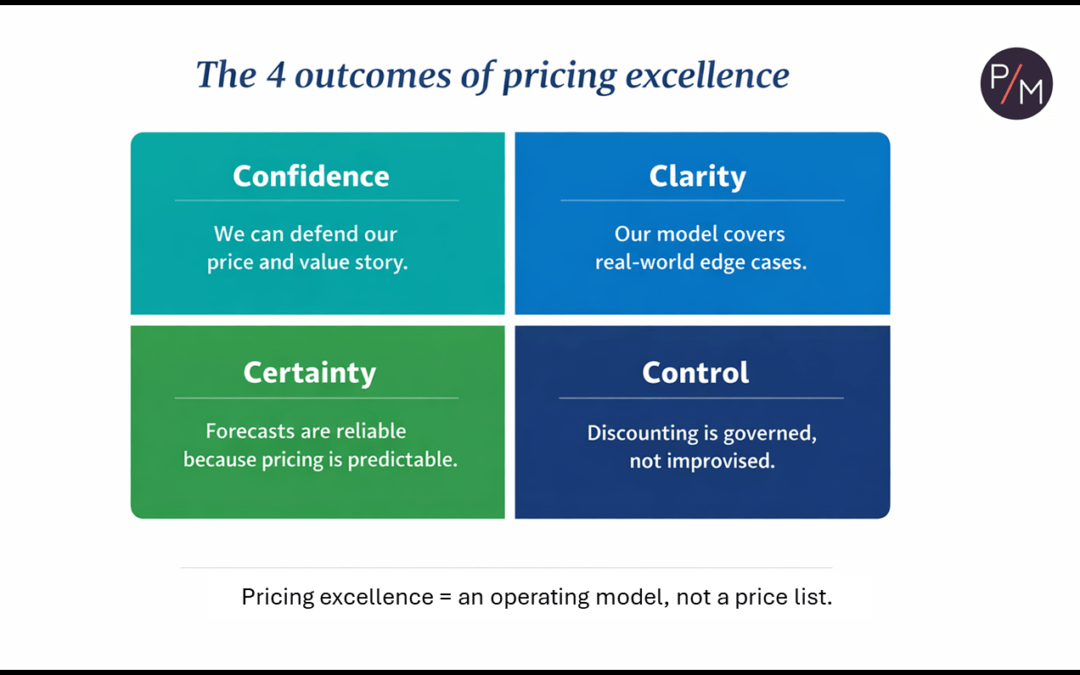
It should deliver four outcomes for leaders:
1) Confidence
You can walk into any commercial conversation and defend your pricing and value story without flinching. Fewer last-minute escalations, more consistent value conversations, and less apologising.
2) Clarity
You have a pricing model that’s defined enough to handle all your edge cases, with clear packaging, firm rules for exceptions, and fewer “we’ll figure it out in the deal” moments.
3) Certainty
You can forecast revenue and margin with far less guesswork because pricing is predictable and repeatable. This means tighter realised price, cleaner renewals, and Finance actually trusting the numbers.
4) Control
You know pricing is being executed as designed and not improvised deal by deal. This leads to less unnecessary discounting, fewer margin leaks and faster decisions.
You don’t need to aim for “perfect pricing”. But you do need to create a pricing system that you can defend, explain and execute consistently.
If pricing still feels like lots of judgement calls rather than a repeatable system, I’m happy to share the framework I use to highlight what’s missing.